The Evolution of ‘Krasnov’: Russian Mafia Associate, KGB Asset, US President, Traitor
How Trump Became A KGB Asset
It
was 1987, and General Vladimir Kryuchkov, head of the KGB First Chief
Directorate, had a recruitment problem — how to improve the quality of
American ‘assets’. Intelligence gathering from American field stations
was disappointing — but, Kryuchkov had a plan.
Kryuchkov
sent out a series of memos — that were shared with British Intelligence
by Oleg Gordievsky — to heads of stations that outlined new
instructions. KGB officers were to ‘be creative’, they should ‘make
bolder use of material incentives’ — that is, money and flattery.
KGB
Heads of Stations were instructed to find ‘U.S. targets to cultivate
or, at the very least, official contacts.’ ‘The main effort must be
concentrated on acquiring valuable agents.’
Kryuchkov
proposed to make wider use of ‘the facilities of friendly intelligence
services’ — Czechoslovakian and East German networks.
Adding,
‘Further improvement in operational work with agents calls for fuller
and wider utilisation of confidential and special unofficial contacts.
These should be acquired chiefly among prominent figures in politics and
society, and important representatives of business and science.’ These
should not only ‘supply valuable information’ but also be able to
‘actively influence’ a target country’s foreign policy ‘in a direction
of advantage to the USSR.’
KGB
case officers were to compile a file on their targets documenting
personal details, a personality assessment: ’Are pride, arrogance,
egoism, ambition or vanity among subject’s natural characteristics?’
The case file should include a section on kompromat:
‘Compromising information about subject, including illegal acts in
financial and commercial affairs, intrigues, speculation, bribes, graft …
and exploitation of his position to enrich himself.’ ‘his attitude
towards women is also of interest.’ ‘Is he in the habit of having
affairs with women on the side?’ Plus ‘any other information’ that would
compromise the subject if exposed to ‘the country’s authorities and the
general public.’ The KGB could…
According
to declassified intelligence files in 2016, Trump may have first
appeared on the KGB radar in 1977 when he married his first wife, Ivana
Zelnickova, a Czech model. Trump became the target of a spying operation
overseen by the Czech intelligence service that probably shared details
with with the KGB. By the time Kryuchkov was implementing his new
American ‘asset’ recruitment plan, Trump had a prominent profile as a
realestate development tycoon. But more, the Czech files recorded a
comment by Ivana that Trump was becoming interested in politics.
In 1980, Trump opened his first big property development, the Grand Hyatt New York hotel near Grand Central station. Trump
bought 200 television sets for the hotel from Semyon Kislin, who owned
Joy-Lud electronics on Fifth Avenue — and also worked for the KGB.
Yuri
Shvets had the rank of major in the KGB. In the 1980s, he was posted to
Washington with a cover job as a correspondent for the Russian news
agency Tass. According to Shvets, Joy-Lud was controlled by the KGB and
Kislin identified Trump, a young businessman on the rise, as a potential
asset. Trump, a young, successful American and interested in politics —
this triggered KGB interest in Trump, and they set out bait and hook
him.
It
was in 1986 when the new Soviet ambassador to the U.N., Yuri Dubinin
would deliberately seek out and successfully charm Trump.
Yuri
Dubinin’s daughter, Natalia Dubinina, was already living in New York,
she was part of the Soviet U.N. delegation. In an interview with
Komsomolskaya Pravda newspaper she recounted her father’s charm
offensive.
She
picked up her father at the airport. As this was his first visit to New
York, she took him on a tour. They came to Trump Tower on Fifth Avenue,
and Dubinin was so excited he decided to go inside to meet the
building’s owner. They took the elevator to the top floor where they met
Trump.
According
to Natalia, her father — ‘fluent in English and a brilliant master of
negotiations’ — charmed Trump, telling him: ‘The first thing I saw in
the city is your tower!’
Natalia
continued: “Trump melted at once. He is an emotional person, somewhat
impulsive. He needs recognition. And, of course, when he gets it he
likes it. My father’s visit worked on him like honey to a bee.’
In
1987, Yuri Dubinin, arranged for Trump and Ivana, to enjoy an
all-expense-paid trip to Moscow to consider possible business. in 1987,
Trump and Ivana visited Moscow and St Petersburg.
Shvets
recalled: “For the KGB, it was a charm offensive. They had collected a
lot of information on his personality so they knew who he was
personally. The feeling was that he was extremely vulnerable
intellectually, and psychologically, and he was prone to flattery.
The
KGB cultivated Trump as part of an ‘active measures’ campaign during
which he was flattered and fed talking points, they even suggested he
should go into politics.
On
Sept 1, 1987, just seven weeks after returning from Russia, Trump ran
full-page ads in the Boston Globe, the New York Times and Washington
Post calling for the dismantling of the postwar Western foreign policy
alliance — NATO. He accused Japan of exploiting the US, and expressed
scepticism about US participation in NATO, questioning ‘on why America
should stop paying to defend countries that can afford to defend
themselves’.
Shvets,
who had returned to Russia, was at the headquarters of the KGB’s first
chief directorate, when he received a message celebrating the ad as a
successful ‘active measure’ executed by a new KGB asset.
In
1988, Trump launched a brief, but abortive, campaign for President. He
even held a campaign rally in Portsmouth, New Hampshire.
The
former head of Kazakhstan’s intelligence service, Alnur Mussayev,
recently stated that Donald Trump was recruited by the KGB in 1987, when
he first visited Moscow. On his KGB file he was given the codename
‘Krasnov’. Further, Mussayev noted that “Today, the personal file of
resident ‘Krasnov’ has been removed from the FSB. It is being privately
managed by one of Putin’s close associates.”
https://uk.news.yahoo.com/donald-trump-recruited-kgb-codename-180759277.html?guccounter=1
Just
after Mussayev made his claim, another ex-KGB officer living in France,
Sergei Zhyrnov, categorically endorsed the allegations in an interview
with a Ukrainian journalist. Watch the interview (in Russian) -
https://www.youtube.com/watch?v=bH6r8Oq-tu4
https://www.politico.com/magazine/story/2017/11/19/trump-first-moscow-trip-215842/
https://www.theguardian.com/us-news/2021/jan/29/trump-russia-asset-claims-former-kgb-spy-new-book
https://www.buzzfeednews.com/article/ilanbenmeir/that-time-trump-spent-nearly-100000-on-an-ad-criticizing-us
https://www.yahoo.com/news/examining-claim-trump-recruited-kgb-030000387.html
https://www.snopes.com/fact-check/kgb-spy-russia/
Trump And The Russian Mafia
By
the early 1990s, Trump’s businesses owed $4 billion to more than 70
banks. By 2009, Trump had spent two decades in court, crashing through
no less than 6 bankruptcies, the most recent in 2004 and 2009.
Trump’s
bankruptcies in the 1990s coincided with Russia’s capital flight after
the break-up of the Soviet Union. What emerged over the next two decades
was a mutually beneficial convergence of crises, a mutual dependency at
first coincidental then deliberate.
To
the Russian mafia, property was a favoured destination for laundering
criminal proceeds that needed to be exfiltrated out of Russia. In 1984,
the Russian Mafia began to use Trump real estate to launder money and
continued to do so for decades.
Transferring
criminal proceeds out of the country required clandestine methods. And
because the Trump organisation had a reputation for not asking too many
questions, Russian money flowed into Trump’s properties.
Helping
with this was Deutsche Bank which actively facilitated the movement of
Russian funds to the West, using methods that bypass normal scrutiny. In
2017, Bloomberg reported that Deutsche Bank earned $629 million from
facilitating ‘mirror trades’ that transferred $10 billion out of Russia
to the West.
Trump,
his family members, and his businesses conduct business through
Deutsche Bank most probably because of its track record at moving
Russian money.
https://www.bloomberg.com/news/articles/2017-01-31/deutsche-bank-fined-204-million-over-money-laundering-failings
In
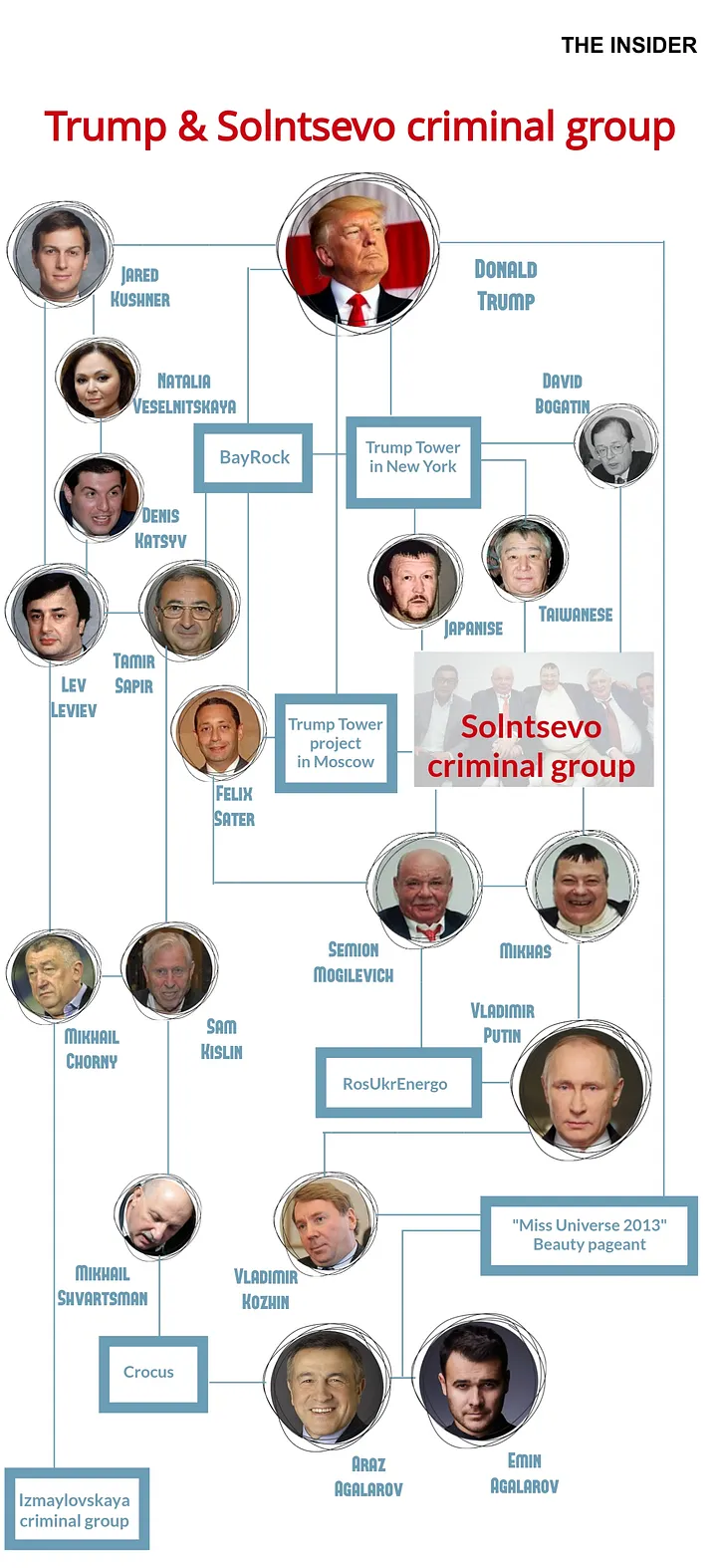
1984, David Bogatin came to Trump Tower with $6 million and bought five
apartments. According to the FBI, Bogatin was a member of the Russian
mafia, a close associate of Semion Mogilevich the ‘Boss of Bosses’ of
the Russian mafia. The apartments were later seized by the government,
which claimed they were used as part of money laundering for the Russian
mafia. (NY Times, Apr 30, 1992)
Bogatin
was the first of many Russian mafia associates — 13 people associated
with the Solntsevso organised crime group and its partner criminal
organisations owned, lived in, and even operated criminal activities out
of Trump Tower or other Trump buildings.
In
1998, the Treasury Department fined the Trump Organization $477,000
after the Internal Revenue Service (IRS) determined that the Trump Taj
Mahal casino in Atlantic City, New Jersey, had violated anti-money
laundering rules more than 100 times in its first 1.5 years of
operations by failing to report gamblers who cashed out more than
$10,000 in a single day. At the time, the fine was the largest ever
assessed for violating the Bank Secrecy Act; however, it pales when
compared with the $10 million the casino had to pay in 2015 when FinCEN
again found the establishment had “willfully violated” anti-money
laundering laws since 2003.
http://www.cnn.com/2017/05/22/politics/trump-taj-mahal/index.html
By
the late 1990s, after Trump’s Atlantic City casinos went bankrupt, no
U.S. bank would deal with him. In 2005, shunned by domestic US
interests, Trump partnered with the Bayrock development group to develop
the Trump SOHO project in Manhattan. Bayrock was headed by Tamir Sapir,
Felix Sater, and Tevfik Arif; all three were associated with the
Russian mafia. Bayrock poured money into the Trump organisation —
licensing his name and property management.
Bayrock,
which financed and developed Trump SoHo, transformed the project into a
money laundering operation, the details for which were documented in
several U.S. lawsuits initiated by Jody Kriss, a finance director at
Bayrock.
Russian-born
Felix Sater is the son of Russian mafia boss Michael Sheferovsky, the
head of a New York criminal group — part of the Mogilevich syndicate —
involved in racketeering and extortion. Mikhail Sheferovsky was an
underboss for Russian Mafia “boss of bosses” Semion Mogilevich.
From
1993, Sater was involved with the Mogilevich group in securities fraud
schemes. But, in 1998, Sater was convicted of fraud in connection to a
$40 million scheme conducted by the Russian Mafia. Following his
conviction, he assisted investigators looking into an international
money laundering scheme involving Viktor Khrapunov, a former government
minister in Kazakhstan accused of laundering more than $3 million in
stolen government funds by purchasing three units in Trump SoHo in the
names of his family members.
In
1999, following a period in prison, he moved into Trump Tower New York
to work with Trump, and was the managing director of Bayrock, located on
the 24th floor of Trump Tower. Sater was a close childhood friend of
Michael Cohen, Trump’s personal lawyer. Cohen’s family owned El Caribe,
which was frequented by the Russian Mafia in Brooklyn. Cohen had ties to
Ukrainian oligarchs through his in-laws and his brother’s in-laws.
Shunned
by Western banks, Trump made frequent overtures to Russian money and
accepted injections of cash from Kremlin-linked figures, such as Dmitry
Rybolovlev. Initially, Trump tried to enter the Russian market through
the Solntsevo criminal group. The SoIntsevo conducted part off its US
operations out of Trump Tower New York.
Between
2007 and 2016 Trump pursued realestate deals in Kazakhstan, Russia,
Georgia, Armenia, Belarus, Iran, Kyrgyzstan, Moldova, Tajikistan,
Turkmenistan, Ukraine, Uzbekistan, and Azerbaijan.
In
2007, at Mar-a-Lago, Trump met with Lev Leviev to discuss potential
deals in Moscow. Austrian police have identified Leviev with Mikhail
Chernoy of the Izmailovo OCG. Leviev is a close friend of Putin. Leviev
was a business partner of Prevezon Holdings (owned by Denis Katsyv, who
was accused of money laundering in the Magnitsky case).
https://www.haaretz.com/us-news/2017-07-25/ty-article/who-is-the-israeli-billionaire-with-ties-to-kushner-and-putin/0000017f-f008-dc28-a17f-fc3f9f6a0000
In
September 2008, Donald Trump Jr. openly boasted of Russian money
‘pouring in’ and that, ‘Russians make up a pretty disproportionate
cross-section of a lot of our assets.’
https://www.eturbonews.com/9788/executive-talk-donald-trump-jr-bullish-russia-and-few-emerging-ma
In
2011–2013, the FBI were monitoring the Nahmad-Tokhtakhunov-Trincher
crime group operating out of Trump Tower New York. The group ran a
large-scale money laundering operation. Tokhathunov had close ties with
the Solntsevo OCG.
In
April 2013, federal agents raided an apartment at Trump Tower in New
York City to disrupt an international crime syndicate run by Alimzhan
Tokhtakhounov. The leaders of the organization were charged with
laundering more than $100 million through shell companies in Cyprus and
the U.S. However, this did not prevent Tokhtakhounov from attending
Trump’s Miss Universe pageant in Moscow in November 2013, as a VIP
guest.
A
2017 Reuters investigation found that that prominant Russians had
invested nearly $100 million in Trump properties located in South
Florida. Many of the units were purchased through anonymous shell
companies, that intentionally made it difficult to identify the ultimate
owner. In 2008, Russian billionaire Dmitry Rybolovlev bought Trump’s
Palm Beach property for $95 million — more than twice what Trump had
paid only four years earlier. This property was bought through an
anonymous shell company, but the ultimate owner was later confirmed.
Russian money flowing into Trump-branded real estate continued elsewhere around the country, especially in New York.
https://www.reuters.com/investigates/special-report/usa-trump-property/
https://www.bloomberg.com/news/articles/2017-03-16/behind-trump-s-russia-romance-there-s-a-tower-full-of-oligarchs
During
the marketing campaign for Trump SoHo, Eric Trump told reporters, ‘As
the experience of the past few years shows, the best property buyers now
are Russian…They’re different in that they can go around without a
mortgage loan from American banks that require income checks, and they
can buy apartments with cash.’ And in 2014, when asked who funded
Trump’s golf courses, he told the sports writer James Dodson, ‘Well, we
don’t rely on American banks. We have all the funding we need out of
Russia. … We’ve got some guys that really, really love golf, and they’re
really invested in our programs. We just go there all the time.’
http://www.wbur.org/onlyagame/2017/05/05/james-dodson-donald-trump-golf
In
2020, the investigative organisation Global Witness, investigated
large-scale money laundering conducted through the Trump Ocean Club in
Panama and found that Russian-speaking real estate brokers targeted
Eastern Europeans as potential buyers.
The
investigation also found that ‘What is clear is that proceeds from
Colombian cartels’ narcotics trafficking were laundered through the
Trump Ocean Club and that Donald Trump was one of the beneficiaries.’
According to the terms of the Panama development, Trump stood to gain more than $75 million.
https://www.globalwitness.org/en/campaigns/corruption-and-money-laundering/narco-a-lago-panama/#chapter-0/section-1
Later,
Sater received multiple subpoenas in the case against Mukhtar Ablyazov
who is alleged to have defrauded BTA Bank of up to $5 billion as
chairman. And in 2020, a lawsuit accused Sater and his partner Daniel
Ridloff of using Trump properties to launder millions of dollars in
stolen funds.
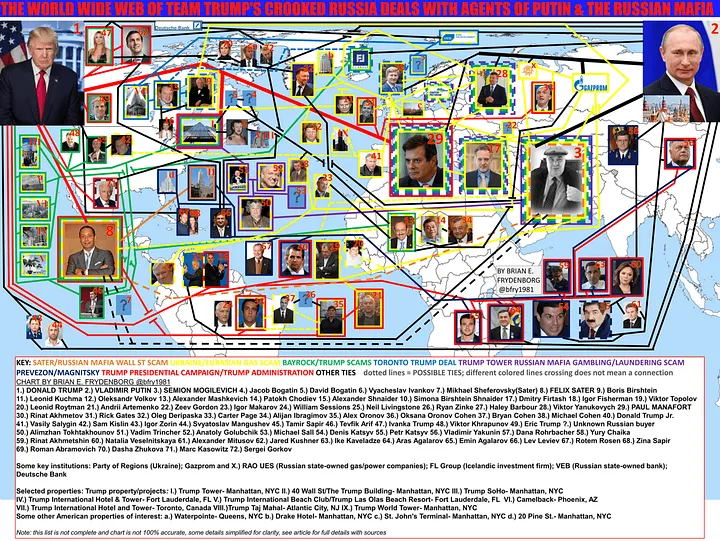
Trump was hosting the Russian mafia for many years before he even ran for president.
Brian
Frydenborg; ‘…in Putin’s cynical salsa with Team Trump, when so many
people connected to Trump and Putin are involved in similar money
laundering schemes involving Russians and the Russian mafia and each
other and Trump properties, we pass out of the realm of allowing for
reasonable doubt and suspicion to the point where the crimes become so
obvious that what remains to be answered is no longer “if” but simply
“how much” these people are guilty…’
https://realcontextnews.com/think-you-know-how-deep-trump-russia-goes-think-again-this-chart-info-will-blow-your-mind/
https://newrepublic.com/article/143586/trumps-russian-laundromat-trump-tower-luxury-high-rises-dirty-money-international-crime-syndicate
https://www.bloomberg.com/view/articles/2017-06-21/trump-russia-and-those-shadowy-sater-deals-at-bayrock
http://www.motherjones.com/politics/2016/09/trump-russian-mobster-tokhtakhounov-miss-universe-moscow/
https://www.dailykos.com/stories/2018/1/23/1735496/-Trump-Crony-Felix-Sater-Subpoenaed-in-New-York-in-Kazakh-BTA-Bank-Heist-Outlined-by-Maddow
https://www.washingtonpost.com/news/wonk/wp/2016/02/29/the-myth-and-the-reality-of-donald-trumps-business-empire/?utm_term=.2a59784614b6
https://www.ft.com/content/159eb2d8-6162-11e7-8814-0ac7eb84e5f1
https://www.ft.com/content/33285dfa-9231-11e6-8df8-d3778b55a923
https://www.buzzfeednews.com/article/anthonycormier/fincen-files-what-banks-said-about-felix-sater-and-100
Trump Election Campaign And Russian Collusion
Based
upon public reporting and indictments by special counsel Robert
Mueller, Trump 2016 campaign and transition team had at least 272 known
contacts and at least 38 known meetings with Russia-linked operatives.
In
a charge brought by special prosecutor Robert Mueller on October 27,
2017, Paul Manafort was named the beneficial owner of the Cyprus company
Lucicle Consultants Limited, which received millions of dollars from
the Ukrainian MP Ivan Fursin. Ivan Fursin, in turn, according to
Austrian police, is an associate of Ukrainian businessman Dmitry
Firtash, and is part of the Russian mafia headed by Semyon Mogilevich.
Manafort
was introduced to pro-Russian Ukraine oligarchs by the American Arthur
J. Finkelstein, a strategist for conservative political campaigns.
https://www.opendemocracy.net/en/5050/dark-money-dirty-politics-and-backlash-against-human-rights/
Finkelstein
ran polarising campaigns that succeeded in securing victory for
Netanyahu in Israel, and Orban in Hungary. Finkelstein remained an
advisor to Orban for 10 years. Finkelstein also worked for other
autocrats of the former Soviet Republics. Finkelstein was also a
long-time associate of Trump. Finkelstein died in 2017.
The
European headquarters of the Russian FSB is located in Budapest. Andras
Gollner Professor Emeritus, at Montreal’s Concordia University,
concluded that there was a link between the Trump 2016 campaign and the
FSB which operated via Budapest.
Trump cooperated with Araz Agalarov to create the 2013 Miss Universe
event in Moscow. Araz’s son Emin was a close associate of Sergei
Mikhaylov the leader of the Solntsevo organised crime group.
Emin
Agalarov arranged the meeting between the lawyer Natalia Veselnitskaya
with Jared Kushner and the leadership of Trump’s election staff, where
she offered dirt on Hillary Clinton and asked for help in repealing the
Magnitsky law.
In
February 2016, it became known that the FBI was investigating whether
funds of the National Rifle Association, of which the deputy chairman of
the Bank of Russia Alexander Torshin was a member, were illegally
funnelled to finance Trump’s election campaign. Torshin was believed to
be a member of the Tagan OCG. In 2016, Spanish authorities considered
arresting Torshin in relation to money laundering.
Andras
Gollner; Hungarian Free Press; “The Budapest Bridge: Hungary’s Role in
the Collusion Between the Trump Campaign and the Russian Secret Service”
and “The Budapest Bridge Part 2″
Trump
made a concerted effort to deny Russian election interference and to
shutdown election interference investigations. He coordinated with
Russia regarding sanctions, and the investigations into election
interference, and concealed discussions with the Russian side.
In
May 2017, before the NATO summit, Trump met with Russian Foreign
Minister Sergei Lavrov and Russia’s Ambassador to the US Sergey Kislyak
in the Oval Office. Trump informed Lavrov and Kislyak that he had fired
FBI Director James Comey. Trump barred US press from attending the
meeting, but allowed TASS news agency to be present.
Trump
spent months pressuring Comey to drop the investigation into former
National Security Advisor Michael Flynn; Trump fired Comey and later
admitted that it was due to “this Russia thing.”
The
general details of the Russian government’s support for Trump in the
2016 election are clear. Russia conducted a massive disinformation
campaign targeting American voters. Russia hacked Trump’s opponents’
email and released the details, some via Wikileaks; and some of Trump’s
team members received advanced notice of the leaks. Russia also used
American fronts to direct financial support into Trump’s campaign and
influence Republican policies.
https://www.nytimes.com/2018/02/16/us/politics/richard-pinedo-russia-bank-accounts-guilty-plea-mueller.html
https://www.vox.com/policy-and-politics/2018/2/16/17021178/mueller-russian-indictments-richard-pinedo-plea-deal
https://themoscowproject.org/explainers/a-case-study-in-collusion/
https://www.npr.org/2017/06/02/531269090/trump-administration-made-secret-efforts-to-ease-russia-sanctions
https://www.nytimes.com/2018/03/21/opinion/donald-trump-russia-putin.html
https://themoscowproject.org/explainers/trumps-russia-cover-up-by-the-numbers-70-contacts-with-russia-linked-operatives/
https://thehill.com/opinion/international/5162890-assessing-new-allegations-that-trump-was-recruited-by-the-kgb/
https://kyivindependent.com/is-donald-trump-a-russian-asset-this-us-author-is-completely-certain-he-is/
https://theins.ru/en/politics/98190
https://theins.ru/en/politics/98262
https://themoscowproject.org/
https://themoscowproject.org/collusion-chapter/chapter-1/index.html
https://www.americanprogress.org/article/cracking-the-shell/
https://www.npr.org/2017/11/08/561059555/trump-used-to-disparage-an-anti-bribery-law-will-he-enforce-it-now
https://csis-prod.s3.amazonaws.com/s3fs-public/publication/1601017_Conley_KremlinPlaybook_Web.pdf
http://abcnews.go.com/Politics/russia-trump-political-conflict-zone/story?id=42263092
https://www.nytimes.com/2017/08/28/us/politics/trump-tower-putin-felix-sater.html?_r=0
https://edition.cnn.com/interactive/2017/03/politics/trump-putin-russia-timeline/
https://www.politico.com/magazine/story/2016/07/donald-trump-2016-russian-ties-214116/
https://www.buzzfeednews.com/article/johntemplon/more-than-a-quarter-of-trumps-overseas-partners-have#.fg2BXLPK7
https://www.theguardian.com/us-news/2017/feb/16/deutsche-bank-examined-trump-account-for-russia-links
https://www.theguardian.com/us-news/2017/feb/14/donald-trump-campaign-russia-intelligence-contact?CMP=Share_iOSApp_Other
https://cdn.themoscowproject.org/content/uploads/2019/01/11122338/MoscowProject-TrumpContacts-0119-1.113.pdf
https://www.americanprogressaction.org/press/release-trumps-russia-cover-numbers-70-contacts-russia-linked-operatives/
A Traitor In Plain Sight
It
is difficult to understand the collective wilful blindness, the
cognitive disconnect in America to Trump’s criminal activities, the
dismantling of US democracy and institutions, the capture of the legal
system, the blatant turn to authoritarian rule by decree, and the active
promotion of Russian foreign policies and objectives.
Trump
has demonstrated a clear and consistent pattern of behaviour toward
Russia that actively advances Russia’s foreign policy objectives while
undermining Western policy cohesion. At every opportunity, Trump has
embraced Putin and adopted positions that align perfectly with Russia’s
foreign policy goals, often favouring the Kremlin over his own country.
Putin’s
seeks to weaken and divide the transatlantic alliance. Putin views NATO
and the transatlantic relationship as Russia’s main strategic
adversaries.
In
support of this, Trump undermines US relationships with European allies
and calls the US’s commitment to NATO into question. When Montenegro
decided to join NATO it prompted criticism from Russia followed by
repeated attacks from Trump.
https://www.theatlantic.com/international/archive/2018/07/trump-montenegro/565475/
During
his first summit with other NATO leaders, Trump refused to reaffirm
America’s commitment to Article 5 of the Atlantic Treaty.
https://www.politico.com/magazine/story/2017/06/05/trump-nato-speech-national-security-team-215227
Trump
considered moving US forces away from Russia’s borders. Kevin
Harrington of the National Security Council proposed withdrawing US
military forces from Eastern Europe. He framed the proposal as an
overture to Putin to “refram[e] our interests within the context of a
new relationship with Russia.”
https://www.thedailybeast.com/white-house-official-floated-withdrawing-us-forces-to-please-putin
In
an interview with The New York Times, Trump stated that the US should
only defend NATO allies who have “fulfilled their obligations to us.”
https://www.nytimes.com/2016/07/22/us/politics/donald-trump-foreign-policy-interview.html
Trump
announced plans to leave the Intermediate-Range Nuclear Forces (INF)
treaty in October 2018 worsening tensions with European allies opposed
to a unilateral US withdrawal.
https://www.cnn.com/2018/10/20/politics/donald-trump-us-arms-agreement-russia/index.html
As
Carl Bildt, former Prime Minister and foreign minister of Sweden,
observes, in just the first two months of Trump’s second term, he and
Rubio have upturned the transatlantic alliance, casting Europe as the
enemy while dismissing security concerns vis a vis Russia — the US
stunned all when it sided with Russia against a UN General Assembly vote
condemning Russia’s war against Ukraine.
Carl
Bildt’s assessment is very insightful; ‘Since MAGA ideologues see open,
liberal European societies as extensions of their enemies at home,
their support for illiberal, anti-democratic forces is perfectly
logical.
They
also have a fundamentally different view of Russia. It is no
coincidence that their rhetoric often echoes that of Russian President
Vladimir Putin’s regime (sometimes almost word for word). MAGA and Putin
alike espouse aggressive nationalism and hostility toward liberal
values; they both carry on endlessly about sovereignty and the role of
strong leaders and strong nations in shaping the future. Whether you are
in the Kremlin or the White House, the so-called globalists are the
enemy.’
However,
the logic of strong leaders and strong nations shaping the future
through aggressive nationalism is that they take by force what they
want, and agree on a carve-up of the world.
https://www.aspistrategist.org.au/the-transatlantic-world-will-never-be-the-same/?utm_medium=email&utm_campaign=Daily%20The%20Strategist&utm_content=Daily%20The%20Strategist+CID_7ab15ca5e160686767ab6a4a7c84f44f&utm_source=CampaignMonitor&utm_term=The%20transatlantic%20world%20will%20never%20be%20the%20same
Putin
works to undermine the European Union and support pro-Russian political
movements. A unified Europe constrains and undermines options for
Russia. The success of a vibrant liberal and democratic EU provides a
direct contrast to Putin’s corrupt regime. EU sanctions strangle Russia
economically, and European unity hinders Russia’s efforts to bully its
neighbours and build transactional alliances with EU members. A Europe
internally divided would enable Russia to threaten former Soviet
satellite states and expand its influence in Europe.
Trump’s
Secretary of State Mike Pompeo went to Brussels to undermine the EU. In
2018, Pompeo gave a speech attacking the European Union and calling on
member states to reassert their sovereignty.
https://foreignpolicy.com/2018/12/07/pompeos-speech-in-brussels-was-tone-deaf-and-arrogant/
Rubio
has continued to attack the EU. Trump has initiated meetings with
Russia to end the war in Ukraine without involving the EU or Ukraine.
Trump has attacked Zelenski, and blamed Ukraine for starting the war.
Trump has suspended intelligence and military support for Ukraine, while
Rubio and Musk have threatened to deny Ukraine access to Starlink.
Trump
has threatened to use military force, and sanctions, if Denmark does
not sell Greenland. Trump is also trying to extort Ukraine’s mineral
resources as payment for the military assistance the US has given; but,
this was actually signalling to Russia which soon after offered Trump
access to rare earth minerals from an occupied Ukraine.
https://www.bbc.com/news/articles/c4gdx7488g5o
https://www.npr.org/2025/02/25/nx-s1-5307012/europe-nato-us-ukraine-russia-eu
Trump
supported National Front leader Marine Le Pen in the 2017 French
presidential election. Le Pen and her far-right National Front party ran
on a platform promising to remove France from the EU. She has a strong
pro-Putin position and has received active financial support from Russia
and a Russian hacking-campaign targeting Le Pen’s opponent.
https://www.politico.com/story/2017/04/21/trump-supports-marine-le-pen-237464
https://www.theguardian.com/world/2017/feb/05/marine-le-pen-promises-liberation-from-the-eu-with-france-first-policies
https://www.politico.eu/article/marine-le-pen-may-have-lost-france-elections-but-the-kremlin-vladimir-putin-is-winning/
https://www.nytimes.com/2017/05/05/world/europe/france-macron-hacking.html
Trump
has repeatedly praised pro-Russia Hungarian Prime Minister Viktor
Orban. And Trump’s 1st administration ambassador to Germany announced
his support for right-wing parties including pro-Russian Austrian
chancellor Sebastian Kurz. While Musk has openly supported the German
AfD.
Putin
would like to disrupt American leadership and dominance of the global
economic order. Putin resents the global economic order and America’s
central role in international finance. The prevailing order confers
significant economic and geopolitical benefits to the US. The US uses
its unique position to leverage access to its capital markets, which
makes tools such as economic sanctions so impactful. Putin aims to
disrupt this system which has been deployed against Russia for several
years.
Trump
is actively pushing for a trade war with all US major trade partners.
He has introduced tariffs on imports from Mexico, Canada, China. During
his 1st term, he applied tariffs on steel and aluminium imports and
threatened tariffs on European cars.
Trump also ended negotiations on the Transatlantic Trade and Investment Partnership (TTIP).
Putin
wants to build global resentment and distrust towards the US. The US
has always been viewed as Russia’s geopolitical rival. The US and
partners have become increasingly critical of each other, longstanding
partnerships based on shared values have been strained. This opens the
way for Russia to create new, more transactional alliances with other
Western nations.
Both Germany and Canada have implied that the era of American global leadership is over.
Following
the May 2017 NATO summit in Brussels, Merkel commented that Germany
could no longer rely on the transatlantic relationship, saying, ‘The
times in which we could rely fully on others — they are somewhat over.
This is what I experienced in the last few days. We Europeans truly have
to take our fate into our own hands.’
Trump’s
decision to impose tariffs on Canadian steel and aluminum prompted
Canadian Prime Minister Justin Trudeau to call it ‘a turning point in
the Canada-US relationship.’
The
German Foreign Office began working on the first-ever America strategy,
with the goal of producing a strategic document that Germany
traditionally develops with respect to its adversaries like Russia.
Anti-Americanism
is increasing. Trump’s destructive presidency has impacted America’s
global influence, as international confidence has fallen from 64% during
former US President Barack Obama’s final years to 22% at the beginning
of Trump’s 1st term.
The Washington Post has defined this as the global story of our times.
Countries should realise that the US is not an ally, but a strategic risk.
https://www.washingtonpost.com/opinions/global-opinions/the-decline-of-us-influence-is-the-great-global-story-of-our-times/2017/12/28/bfe48262-ebf6-11e7-9f92-10a2203f6c8d_story.html?utm_term=.adcc324993bf
https://www.newyorker.com/news/letter-from-trumps-washington/under-trump-america-first-really-is-turning-out-to-be-america-alone
http://www.pewglobal.org/2017/06/26/u-s-image-suffers-as-publics-around-world-question-trumps-leadership/
Putin needs to relieve economic and domestic political pressure from US sanctions on Russia.
US
and European sanctions against Russia have impacted the Russian economy
and have personally impacted Russian oligarchs and officials on whom
Putin depends. Russia’s 2015 national security strategy stated the goal
of creating a ‘favourable external environment that would allow Russia’s
economy to grow steadily and become more competitive.’ — sanctions
undermine this goal.
https://www.csis.org/analysis/unpacking-russias-new-national-security-strategy
Trump
lifted sanctions on three companies linked to Oleg Deripaska, a Russian
oligarch and Putin ally who was linked to the Russia investigation. The
sanctions were intended as retaliation for election interference.
Deripaska helped fund former Trump campaign manager Paul Manfort’s work
on behalf of Russian interests for years.
https://www.nytimes.com/2018/12/19/us/politics/sanctions-oleg-deripaska-russia-trump.html?module=inline
https://www.nytimes.com/2019/01/21/us/politics/oleg-deripaska-russian-sanctions.html
https://www.apnews.com/122ae0b5848345faa88108a03de40c5a
https://www.theguardian.com/us-news/2018/aug/22/paul-manafort-went-to-kyrgyzstan-to-strengthen-russias-position
At
the start of the 1st Trump administration, Trump moved to repeal
Obama-era sanctions. The State Department was tasked with developing a
plan to lift existing sanctions against Russia, restore diplomatic
compounds from which Obama had expelled Russian diplomats in retaliation
for the 2016 election interference, and take steps to placate Moscow.
https://www.yahoo.com/news/trump-administrations-secret-efforts-ease-russia-sanctions-fell-short-231301145.html
The
US Congress was opposed to lifting sanctions against Russia, passing
the Countering America’s Adversaries Through Sanctions Act (CAATSA)
through both houses by an overwhelming majority. But, Trump condemned
the legislation as ‘seriously flawed’ and unconstitutional.
https://www.cnbc.com/2018/01/29/new-us-russia-sanctions-trump-to-comply-but-impact-will-be-minimal.html
https://www.thedailybeast.com/trump-admin-lobbied-lawmakers-to-weaken-russia-sanctions
Trump
deliberately failed to properly implement the requirements of the
legislation, delayed the sanctions, and ensured that reporting and
impact assessment requirements were so poorly done as to render them
useless.
https://www.thedailybeast.com/dems-demand-answers-from-trump-on-russia-sanctions-delay
https://www.washingtonpost.com/news/worldviews/wp/2018/01/30/the-kremlin-list-why-russian-oligarchs-shrugged/
http://foreignpolicy.com/2018/01/30/trump-administration-says-no-to-new-sanctions-yes-to-cribbing-from-forbes-kremlin-russia-state-treasury/
https://www.bloomberg.com/news/articles/2017-11-27/bond-sanctions-could-have-more-impact-than-russia-is-making-out
https://www.bloomberg.com/news/articles/2018-02-02/treasury-warns-of-widespread-effects-of-russian-debt-sanctions
The
sanctions that were eventually announced were limited to people already
sanctioned rendering the effort meaningless. Additional sanctions were
deployed in April 2018, but these were also incomplete. Instead the only
serious effort was directed to lifting sanctions on Oleg Deripaska.
Trump has continued to advocate for Putin’s views on US sanctions.
https://www.bloomberg.com/news/articles/2019-01-16/democrats-lose-bid-to-keep-sanctions-on-deripaska-related-firms
Putin aspires to international legitimacy for his regime.
Trump
is all to willing to help. He publicly dismisses concerns about Putin
and offers Putin public praise, while also hiding meetings and
coordination with Putin.
Trump
tried to hide the content of at least five meetings with Putin from
U.S. government officials. After a 2017 meeting in Hamburg, Trump
confiscated notes from his interpreter and instructed him to not tell
any other officials what happened in the meeting. During the 2018 G20 in
Argentina, Trump met with Putin for a brief conversation without a
translator or note taker.
https://www.washingtonpost.com/world/national-security/trump-has-concealed-details-of-his-face-to-face-encounters-with-putin-from-senior-officials-in-administration/2019/01/12/65f6686c-1434-11e9-b6ad-9cfd62dbb0a8_story.html?utm_term=.15d49e2d1907
https://www.ft.com/content/61842ec4-23a0-11e9-8ce6-5db4543da632
At
the 2018 Helsinki Summit, Trump rejected the combined US intelligence
agencies’ analysis that Russia tried to influence the 2016 US election,
with a state-authorised campaign of cyber attacks and fake news stories
posted on social media. Instead, Trump accepted Putin’s denial without
challenge, even though 2 days before the summit, Robert Mueller had
indicted 12 Russian military officers. Trump even condemned the 2016
Russian election interference investigation. Trump excused Russia by
saying that other countries may have been responsible.
https://www.nytimes.com/2017/11/11/world/asia/trump-putin-election.html
https://www.washingtonpost.com/opinions/global-opinions/trump-just-put-russia-first/2018/07/16/8391f9aa-8914-11e8-a345-a1bf7847b375_story.html?utm_term=.77702b921894
Trump
made a concerted effort to deny Russian election interference and to
shutdown election interference investigations. He coordinated with
Russia regarding sanctions, and the investigations into election
interference, and concealed discussions with the Russian side.
In
May 2017, before the NATO summit, Trump met with Russian Foreign
Minister Sergei Lavrov and Russia’s Ambassador to the US Sergey Kislyak
in the Oval Office. Trump informed Lavrov and Kislyak that he had fired
FBI Director James Comey. Trump barred US press from attending the
meeting, but allowed TASS news agency to be present.
Trump
spent months pressuring Comey to drop the investigation into former
National Security Advisor Michael Flynn; Trump fired Comey and later
admitted that it was due to ‘this Russia thing.’
https://www.cnn.com/2017/06/07/politics/james-comey-testimony-released/index.html
https://www.nytimes.com/2017/05/09/us/politics/james-comey-fired-fbi.html?mtrref=t.co
https://www.washingtonpost.com/news/politics/wp/2018/01/05/timeline-what-we-know-about-trumps-decision-to-fire-comey/?utm_term=.4ad5ecf7a077
Putin’ aims to revive Russia’s status as a great power and gain international acceptance for its seizure of Crimea.
Russia’s
2015 national security strategy explicitly stated that one of the
country’s goals is to ‘[consolidate] the Russian Federation’s position
as a centre of influence in today’s world.’
Western
leaders condemned Putin’s 2014 annexation of Crimea, and in response
implemented sanctions against Russia’s economy and they expelled Russia
from the G8.
https://www.washingtonpost.com/world/transcript-putin-says-russia-will-protect-the-rights-of-russians-abroad/2014/03/18/432a1e60-ae99-11e3-a49e-76adc9210f19_story.html?utm_term=.777985e8f871
https://www.csis.org/analysis/unpacking-russias-new-national-security-strategy
Trump
called Crimea part of Russia. At the 2018 G7 summit in Canada, Trump
told G7 leaders that ‘Crimea is Russian because everyone who lives there
speaks Russian.’
https://www.washingtonpost.com/world/transcript-putin-says-russia-will-protect-the-rights-of-russians-abroad/2014/03/18/432a1e60-ae99-11e3-a49e-76adc9210f19_story.html?utm_term=.ea9fe1a266ac
https://www.buzzfeed.com/albertonardelli/trump-russia-crimea?utm_term=.sw0RWOZQ5#.kpYZ4rnLb
Trump
is also trying to restore Russia’s international standing. At the 2018
G7 summit, Trump said, ‘we should have Russia at the negotiating table.’
— advocating for the restoration of Russia’s membership by claiming
that everyone benefits.
https://abcnews.go.com/Politics/trumps-call-russia-join-g7-faces-swift-backlash/story?id=55750098
Before
the 2017 G20 summit, Trump had a list of concessions prepared which he
presented at his first bilateral meeting with Putin. There was strong
resistance to the meeting from the State Department and National
Security Council who recognised that it would signal acceptance of
Russia’s interference in the 2016 election and the annexation of Crimea.
During
the G20, Trump held a second meeting with Putin but neither the
National Security Advisor H.R. McMaster nor the Senior Director for
Europe and Eurasia Fiona Hill were present. Incredibly, only the
Kremlin’s interpreter was present for the meeting — no US official has a
record of what occurred.
https://www.theguardian.com/us-news/2017/jun/29/white-house-sanctions-first-trump-putin-meeting
https://www.forbes.com/sites/paulroderickgregory/2017/07/07/what-really-happened-at-the-trump-putin-meeting-in-hamburg-germany/#346ca41e428f
https://www.nytimes.com/2017/07/18/world/europe/trump-putin-undisclosed-meeting.html
Putin
seeks to disrupt Western elections, and to promote discord across
Western democracies while limiting repercussions for interfering in
American and European elections.
The
Trump administration has undermined the US government’s main tool for
combatting Russian disinformation, the State Department’s Global
Engagement Center (GEC). GEC was specifically ‘tasked with countering
Moscow’s disinformation campaign.’ However, the centre has suffered from
a lack of Russian speaking analysts, a hiring freeze, and budget
restrictions.
https://www.nytimes.com/2018/03/04/world/europe/state-department-russia-global-engagement-center.html
https://www.vanityfair.com/news/2018/04/russia-propaganda-america-information-war
Trump
has undermined America’s cyber defenses. Trump administration has
limited the government’s ability to coordinate a coherent cybersecurity
policy. The State Department tried to close the Office of Cybersecurity
Coordinator until Congress intervened. The former National Security
Agency head Admiral Mike Rogers stated he had not been granted the
authority by the White House to counter Russian cyber operations ‘where
they originate.’
And
Trump even discussed forming a ‘Cyber Security unit’ with Putin when
they met at the Hamburg G20 summit in July 2017. Putin reportedly again
suggested a cybersecurity working group at the Helsinki summit.
http://thehill.com/policy/cybersecurity/369388-house-votes-to-restore-state-cyber-office-bucking-tillerson
https://www.nytimes.com/2018/02/27/us/politics/michael-rogers-nsa-cyber-command-russia-election-meddling.html
https://www.politico.com/story/2017/07/09/trump-pitches-cyber-security-task-force-with-putin-240332
https://www.washingtonpost.com/world/national-security/russia-continues-to-shape-narrative-of-helsinki-summit/2018/07/20/3ea54a98-8c40-11e8-a345-a1bf7847b375_story.html?utm_term=.bafbf88b981d
In
October 2017, the administration closed the State Department’s
sanctions office, eliminating the Coordinator for Sanctions Policy. The
responsibilities of this office once led by a veteran diplomat and a
team of five, have been moved to a single person who works on the topic
part time.
http://foreignpolicy.com/2017/10/26/state-department-scraps-sanctions-office/
Putin would like to soften America’s adversarial position on Russia.
Trump
and the Republicans blocked moves to maintain sanctions against Putin’s
close associate Oleg Deripaska. After the Helsinki summit, Trump twice
extended an invitation to Putin to visit the US, despite intense
opposition to the idea.
Trump
directed that the Republican National Committee platform on Ukraine
support should be weakened. Trump’s constant campaigning on behalf of
Russia led to a Republican delegation travelling to Russia to pursue
renewed US/Russia relations.
https://www.cnn.com/2017/06/15/politics/russia-sanctions-senate-trump/index.html
https://www.reuters.com/article/us-usa-russia-bolton-putin/white-house-invites-putin-to-washington-idUSKCN1N012X?feedType=RSS&feedName=topNews&utm_medium=Social&utm_source=twitter
https://www.nytimes.com/2018/07/19/us/politics/trump-putin-browder-mcfaul.html
https://www.thedailybeast.com/trump-campaign-changed-ukraine-platform-lied-about-it
https://www.washingtonpost.com/opinions/eight-republicans-spent-july-4-in-russia-where-are-the-fireworks/2018/07/06/beae30be-812e-11e8-b658-4f4d2a1aeef1_story.html?utm_term=.06ff5282b98e
https://www.washingtonpost.com/world/europe/republican-lawmakers-come-to-moscow-raising-hopes-there-of-us-russia-thaw/2018/07/03/1213130c-7e94-11e8-b0ef-fffcabeff946_story.html?utm_term=.376e88ae9bcc
https://www.reuters.com/article/us-usa-russia-putin-trump/kremlin-coy-on-new-summit-idea-says-putin-and-trump-can-meet-at-g20-idUSKBN1KE1R8
https://www.npr.org/2017/12/04/568310790/2016-rnc-delegate-trump-directed-change-to-party-platform-on-ukraine-support
Putin
drives concealed efforts to destabilise the US from within. Russia
seeks to promote preexisting divisions within US society, which they
view as a way to distract and weaken an adversary.
https://www.theatlantic.com/international/archive/2017/10/russia-facebook-race/542796/
Trump attacks US institutions while driving divisive politics and eroding democratic norms.
Trump
has been actively hostile toward the press, denouncing journalists as
‘the enemy of the American people’ and popularizing the term ‘fake news’
(a term used by Hitler to attack the press) to undermine credible
institutions like The New York Times, The Washington Post, and CNN.
Trump
is violating established norms, using his power to silence his critics;
he has weaponised the Dept of Justice and courts for the same purpose.
Trump has publicly defended neo-Nazis and repeatedly used racially-charged language.
Following
the August 2017 white nationalists’ march in Charlottesville that
resulted in the death of one counter-protester, Trump said the white
nationalists included some ‘very fine people’. Trump retweeted three
propaganda videos from a British hate group which falsely claimed to
depict Muslim migrants attacking white citizens.
https://abcnews.go.com/Politics/trump-stalin-enemy-people-language-gop-senator-speech/story?id=52327959
https://www.theatlantic.com/politics/archive/2017/08/trump-defends-white-nationalist-protesters-some-very-fine-people-on-both-sides/537012/
https://www.vox.com/policy-and-politics/2017/11/29/16714788/trump-retweet-britain-first-islamophobia
Trump
has actively instituted discriminatory policies including ‘muslim
bans’, ‘zero tolerance’ policies against immigrants from Central and
South America, and the erasure of LGBT and equity programs.
Trump
has advanced conspiracy theories that undermine the democratic process
including deliberately false claims of election fraud, and ‘deep state’
conspiracies.
https://www.vanityfair.com/news/2018/05/trump-deep-state-coup-hysteria
Putin’s seeks to advance the Kremlin’s narrative to shape global perceptions.
Trump
has gone out of his way to repeat Russia’s position across as range of
topics, especially on Ukraine and NATO while rejecting US intelligence
assessments regarding Russian election interference and disinformation,
criticising the FBI and CIA, and uncritically accepting assurances from
Putin.
Thank
you for reaching this point; it is a long read. This article provides
the background to Trump’s Russian connection. However, it is not the end
of the story. The more alarming part of the story is the compelling
parallels between Trump’s rise and the rise of the Nazis. Trump is
extremely dangerous, and I urge everyone to read about Trump’s adoption
of Hitler’s methods outlined in the story below.
https://medium.com/predict/the-loss-of-historical-consciousness-and-the-revenges-of-history-a6cafc4f885e